Although over 70% of the earth’s surface is made up of water, over 99% of this is unusable by humans. As our water supply is becoming increasingly scarce, we are considering our water usage more closely.
From looking for renewable sources when we compare business energy to turning the tap off when we brush our teeth, many of us are doing our bit to be more eco-conscious, but which countries are guilty of the worst water-related habits? After previously revealing the countries using the most water in our Global Water Footprint, we were keen to find out how much has changed. Here’s what we found.
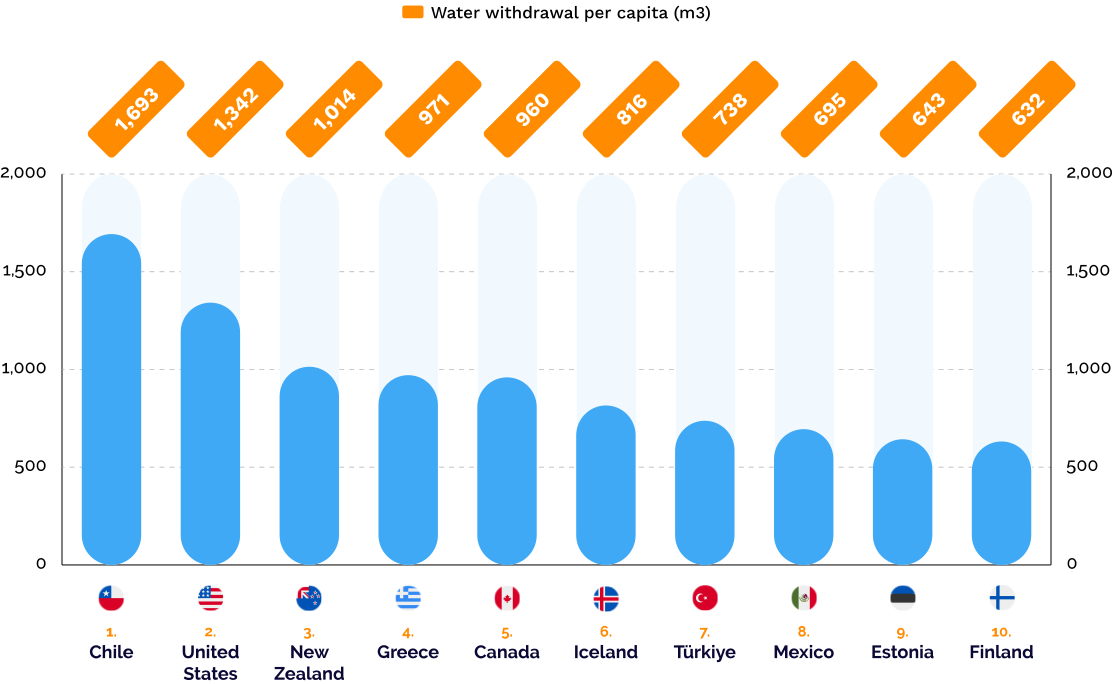
To kick off our refreshed Global Water Footprint, we have compiled a list of the OECD countries responsible for the most significant water withdrawal per capita as of 2020.
Totalling 1,693m3 per capita, Chile has a larger water withdrawal than any other country on our list. This country's mining industry is vital, with copper mining contributing largely to Chile's economy. Unfortunately, vast amounts of water are needed to carry this out, which has undoubtedly contributed to this country's position on our ranking
Water withdrawal per capita:
The United States appears next on our list of countries with the most extensive water withdrawal per capita. As one of the most populated countries in the world, it makes it even more astonishing that each person in the United States is withdrawing over 1,300m3 of water per year.
Water withdrawal per capita:
Completing our list by withdrawing 1,014m3 of water per capita is New Zealand. With abundant sunshine across the year, the residents here are likely to use water for various domestic purposes, including watering their lawns and maintaining the upkeep of pools.
Water withdrawal per capita:
|
|
Country |
|
|---|
Freshwater can be extracted from lakes, rivers, and the ground, but this can have negative consequences for surrounding plants and animals when done on a large scale. Below is a list of countries with the most significant total freshwater withdrawals.
Of all OECD countries, the United States has withdrawn the largest amount of freshwater - totalling 444.4bn cubic metres as of 2020. The United States is known for its impressive plethora of lakes, and this country has been making the most of the resources in these freshwater sites.
Freshwater withdrawal (10^9 m3)
It is estimated that only around 70% of people in Mexico have access to fresh water, making it even more surprising to see this country feature second on our list. The 89.5bn cubic metres of freshwater here are harnessed mainly for agriculture and livestock, with aquifers playing a massive part in groundwater storage.
Freshwater withdrawal (10^9 m3)
With many dams and improved water sanitation, Japan has changed their water access so as not to become a cropper to the effects of climate change. Japan has capitalised on freshwater sources, tallying up 78.4bn cubic metres of freshwater withdrawal in 2020.
Freshwater withdrawal (10^9 m3)
|
|
Country |
|
|---|
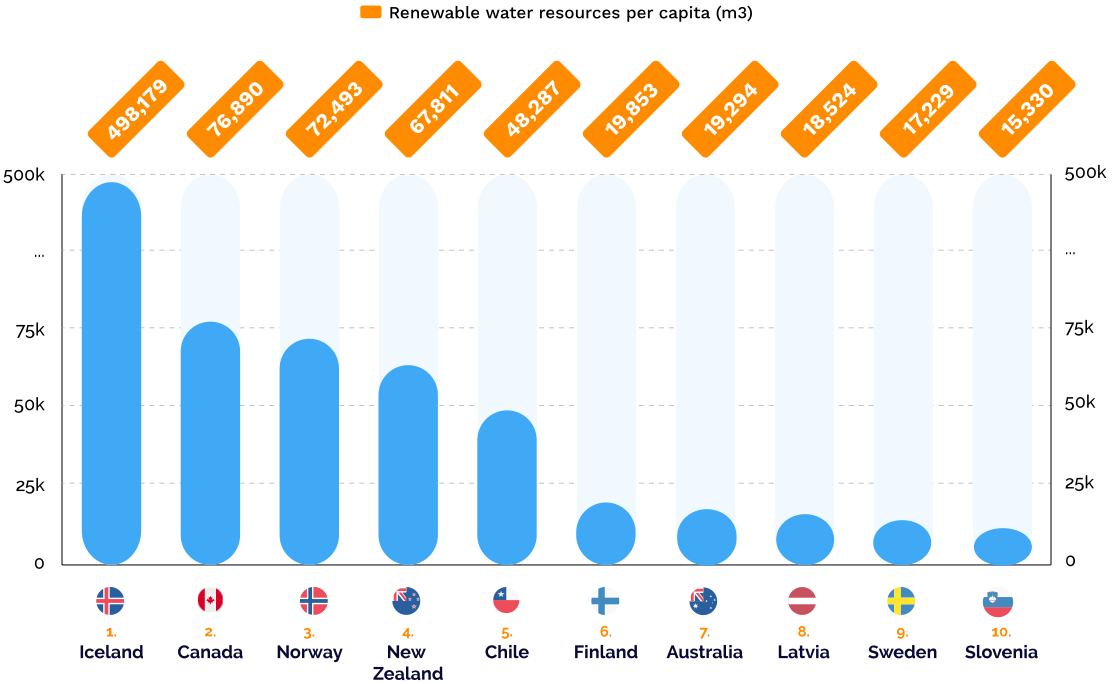
Water supply certainly isn’t infinite, but when optimised, we can use renewable resources to replenish water in ways that cause minimal stress to the planet. Below is a list of the countries with the most renewable water resources per capita.
Iceland is known for its extensive renewable energy sources; water is no exception. Despite having less than 400,000 inhabitants, this country has more renewable water resources than any other area on our list - totalling 498,179m3 per capita.
Renewable water resources per capita (m3)
Canada is home to around 7% of all renewable freshwater resources derived from rivers, lakes, and groundwater. This country also harnesses its snowfall by converting it into a source of fresh water. These factors have contributed to Canada's 76,890m3 of renewable water resources per capita.
Renewable water resources per capita (m3)
Norway completes our top three list of OECD countries with the most renewable water resources. With over 72,000m3 per capita, this Scandinavian country falls just shy of the second spot. Most public water here is supplied through groundwater, and this country uses aquifers to support biodiversity.
Renewable water resources per capita (m3)
|
|
Country |
|
|---|
As the population continues to grow, so does our water usage. Unfortunately, the earth’s water supply does not increase with the people, so we must conserve water in the best ways possible. Whilst most of us would like to reduce our water footprint, we understand that it may be daunting. Because of this, we have prepared a series of expert tips to help you become a water-saving expert.
Just as hot water needs time to warm up, cold water can take some time to pass through our taps. While it may not seem like much, the amount of wasted water soon adds up, and this can set you back a noticeable amount on your water bill. To avoid this unnecessary cost, we suggest you fill up a bottle or jug and place it in your fridge so that you always have a cold water source at your disposal.
Any way you wash your dishes will result in you using water, but if you want to get the most out of your water supply, we recommend using a bowl and washing your dishes by hand. Whilst it may take a bit more time and effort compared to chucking everything in a dishwasher, the money saved by this method will be worth it.
You are losing out on valuable water, whether you’ve accidentally left your tap running or have a leak under your sink. If you don’t fancy watching your money go down the drain, you should consider informing your landlord of the issue or hiring a plumber to help you.
It is well known that having a shower uses much less water than taking a bath, but there are ways you can go the extra mile if you are still looking to cut down your water usage. Finding the best business electricity rates can save you money, but an eco-showerhead will do wonders for your water usage while also doing your bit for the environment.
We used Aquastat to find the following data for all OECD countries as of 2020: total renewable water resources per capita, total freshwater withdrawal, and total water withdrawal per capita.